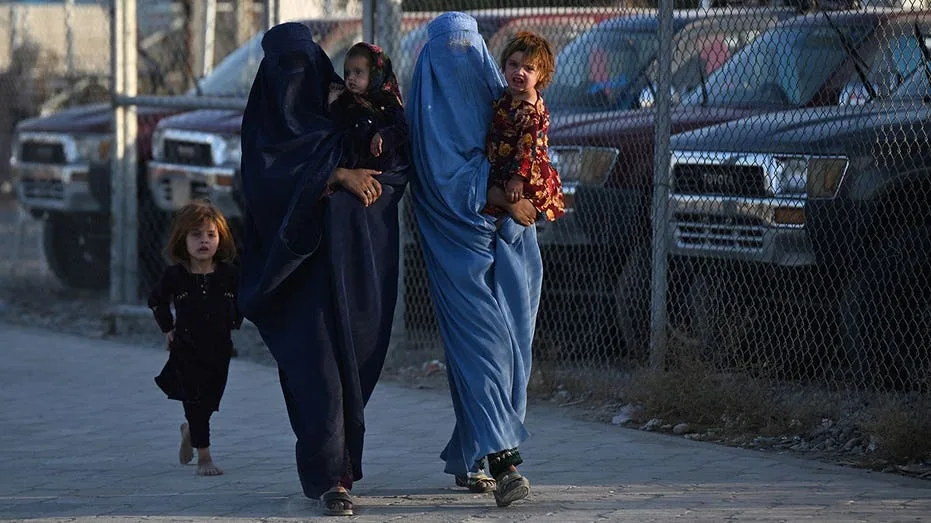
Reports from Afghanistan indicate that the Taliban administration has reportedly prohibited the use of women's given names on official documentation within the northern province of Balkh. This new directive, detailed by the Spanish newspaper El País, suggests some women are being referred to by derogatory terms, including animal names.
This latest measure, seen as a further erosion of women's rights under Taliban governance, reportedly extends to medical records and prescription forms in Balkh province, sparking concerns that similar restrictions could eventually be implemented nationwide.
Healthcare professionals and other public sector employees have reportedly received instructions to address women using the term "Bibi," which translates to grandmother or old woman. This information comes from reports by the Afghan news outlet Zan Times and The Guardian, as cited by El País.
Lalah Osmany, an Afghan women's rights advocate based in Germany, informed El País that accounts from women, medical practitioners, and civil rights activists suggest some individuals are also being called by demeaning labels such as "goat" or "cow."
This is a systematic process of dehumanization.
Osmany characterized this development as "a systematic process of dehumanization." An Afghan activist, speaking anonymously, corroborated the reported order to El País, though she noted that it has largely been disregarded so far.
Widespread Restrictions and Potential Expansion
Zubaida Akbar, who oversees the Afghanistan initiatives for the women's rights organization Femena, cautioned that the Taliban might eventually enforce this ban across the entire country. She referenced previous instances where localized restrictions were later expanded nationally.
According to El País, Femena has documented over 144 decrees that curtail the rights of Afghan women since the Taliban's return to power.
The newspaper further reported that girls are prohibited from continuing their education past the age of 12, while women have been excluded from most professional fields and face limitations on public speaking.
Despite these severe constraints, some Afghan women have established clandestine businesses and secret educational facilities, operating in defiance of the Taliban's edicts, as reported by the Associated Press on November 17.
One owner of a beauty salon in Kabul, whose identity remains protected for security reasons, managed to reopen her establishment after authorities previously raided her original salon and seized her equipment. "But now, they won’t even allow that; for women in Afghanistan, working has become a crime," she conveyed to the Associated Press.
An assistant teacher at an underground school in Kabul described living with constant apprehension of arrest. "We are absolutely terrified of that possibility," she told the Associated Press.
Mohammad Aslam, a spokesperson for the Taliban's Ministry for the Promotion of Virtue and Prevention of Vice, defended the broader spectrum of restrictions in comments to the Associated Press. He asserted that women are permitted to engage in business and social activities provided they adhere to Islamic Sharia law and existing regulations.
Medical Risks and Eroding Identity
Osmany also raised concerns that the reported prohibition on using women's names could jeopardize female patients, potentially increasing the likelihood of medical errors if prescriptions and health records are filed under identical or generic designations.
Afghan women already encounter significant obstacles to accessing healthcare under Taliban rule, including prohibitions on male doctors treating female patients and bans on women pursuing medical training, as reported by El País.
In 2017, Osmany initiated a campaign advocating for the inclusion of Afghan women's names on official documents, such as their children's birth certificates.
Despite receiving threats against her life from extremist groups, her campaign successfully led to a policy change in 2020, which allowed mothers' names to be voluntarily added to such documents. However, this hard-won progress proved temporary.
Historical Context and Resistance
The Taliban regained control of Afghanistan in August 2021, following the collapse of the U.S.-backed Afghan government amidst the military withdrawal orchestrated by then-President Joe Biden. This event left the nation once more under the governance of Islamist extremist factions.
The withdrawal faced widespread criticism, particularly after an ISIS-K terrorist attack during the evacuation from Kabul resulted in the deaths of 13 American service members, primarily Marines.
President Biden further drew censure from Gold Star families after being observed checking his watch during the dignified transfer ceremony for the fallen American troops at Dover Air Force Base in Delaware.
Nearly five years since the Taliban's takeover, Afghan women and girls have witnessed the systematic dismantling of freedoms they had previously gained. Now, activists warn, their very personal identities are facing an existential threat.
Calling a woman by her real name in Afghanistan is an act of resistance.
Osmany emphasized the significance of individual recognition, stating to El País, "Calling a woman by her real name in Afghanistan is an act of resistance."